As components become smaller and more powerful, heat dissipation challenges continue to increase. Selecting the right DC cooling fan can directly affect equipment performance, reliability, service life, and energy efficiency.
Among the most commonly used DC cooling solutions, DC axial fans and DC centrifugal fans are two popular options. While both are designed to provide forced air cooling, they work differently and perform better in different application environments.
This article will explain the differences between DC axial fans and DC centrifugal fans, compare their performance characteristics, and help you select the right cooling solution for your project.

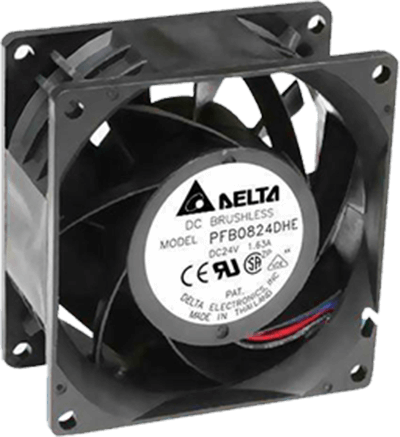
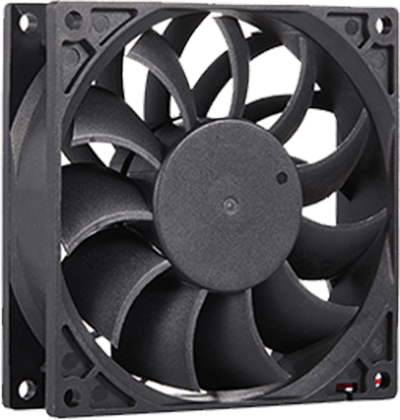
A DC axial fan is a cooling fan that moves air parallel to the axis of rotation. When the fan operates, the blades rotate and push air directly through the fan housing, creating a straight airflow path.
DC axial fans are powered by direct current (DC) motors, which typically offer advantages such as low power consumption, compact size, and easy speed control. Many modern DC axial fans also feature brushless DC (BLDC) motors, providing longer service life and improved reliability.
DC axial fans are widely used in applications where large volumes of air need to be moved with relatively low resistance, such as:

A DC centrifugal fan, also known as a radial fan or blower fan, operates by drawing air into the center of the impeller and redirecting it outward at a 90-degree angle. This design allows centrifugal fans to generate higher static pressure compared with axial fans.
Like DC axial fans, DC centrifugal fans use DC motors, often with brushless technology, to provide efficient and reliable airflow control.
Key Features of DC Centrifugal Fans:
DC centrifugal fans are ideal for applications where air must pass through filters, ducts, heat sinks, or other airflow restrictions.
Common applications include:
Although both fans provide active cooling, their airflow characteristics and application advantages are different.
|
Comparison Factor |
DC Axial Fan |
DC Centrifugal Fan |
|
Airflow Direction |
Air moves parallel to the fan axis |
Air enters axially and exits radially |
|
Airflow Performance |
Higher airflow volume |
Lower airflow volume but stronger pressure |
|
Static Pressure |
Low to medium pressure |
Medium to high pressure |
|
Cooling Method |
Direct ventilation |
Forced airflow through resistance |
|
Installation Space |
Requires open airflow path |
Suitable for compact or enclosed spaces |
|
Noise Level |
Generally lower at normal airflow conditions |
May produce higher noise at high pressure operation |
|
Energy Efficiency |
Efficient for free-air cooling |
Efficient for pressure-demanding systems |
|
Structure |
Simple and lightweight |
More complex impeller design |
|
Cost |
Usually more economical |
Generally higher due to design complexity |
When selecting a DC cooling fan, airflow and static pressure are two of the most important technical parameters.
Airflow refers to the volume of air a fan can move within a certain period, usually measured in:
CFM (Cubic Feet per Minute)
m³/h (Cubic Meters per Hour)
A higher airflow rating means the fan can move more air, which is beneficial for cooling large open spaces.
DC axial fans typically provide higher airflow compared with centrifugal fans, making them suitable for applications requiring rapid heat removal.
Static pressure measures the fan’s ability to overcome airflow resistance.
Airflow resistance can come from:
When a cooling system has high resistance, a standard axial fan may not provide sufficient airflow.
In these cases, a DC centrifugal fan performs better because it can generate higher pressure and maintain stable airflow.
For example:
A centrifugal fan is often the better solution.
There is no universal “best” cooling fan. The right choice depends on your equipment design and thermal requirements.
|
Application Requirements |
Recommended Fan Type |
Reason |
|
Need maximum airflow in open space |
DC Axial Fan |
Provides high-volume airflow efficiently |
|
Limited installation space |
DC Centrifugal Fan |
Compact design with flexible airflow direction |
|
Airflow must pass through filters or ducts |
DC Centrifugal Fan |
Higher static pressure capability |
|
Cooling large electronic cabinets |
DC Axial Fan |
Effective ventilation and heat removal |
|
Cooling precision equipment |
DC Centrifugal Fan |
Stable airflow under resistance |
|
Low-cost cooling solution |
DC Axial Fan |
Simple structure and economical |
|
High-performance thermal management |
DC Centrifugal Fan |
Better pressure performance |
Choosing the right fan manufacturer is just as important as selecting the right fan type. A reliable cooling fan supplier can provide optimized solutions based on your application requirements instead of simply offering standard products.
When evaluating a DC cooling fan manufacturer, consider the following factors:
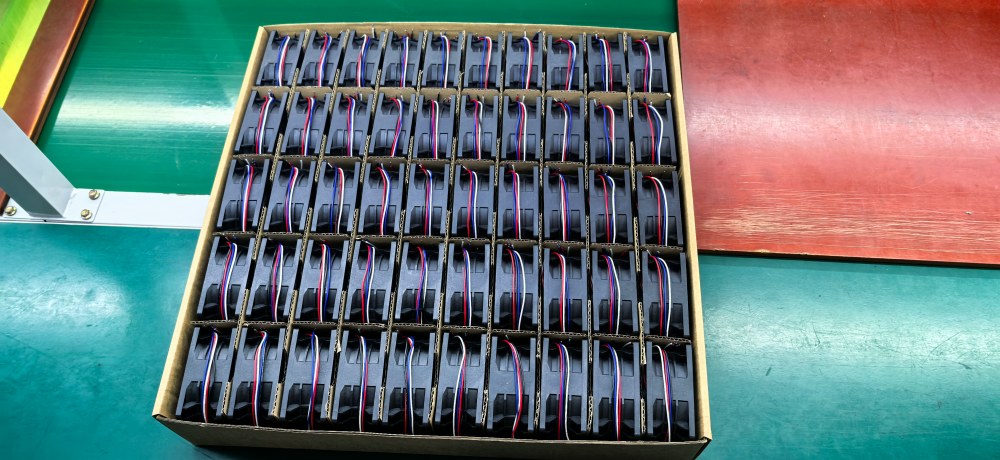
Different applications require different cooling specifications. A professional manufacturer should provide customized solutions.
Cooling performance depends on more than just fan size. Experienced engineers can help analyze: Thermal requirements; Airflow paths; Pressure conditions; Installation limitations.
Professional technical support helps ensure the selected fan delivers reliable performance.
A high-quality DC fan should provide:
Manufacturers with strict quality control processes can help reduce equipment failures and maintenance costs.
A manufacturer with experience across multiple industries can better understand application challenges in areas such as:
Both DC axial fans and DC centrifugal fans play important roles in modern cooling systems. DC axial fans are ideal for applications requiring high airflow, simple ventilation, and cost-effective cooling. DC centrifugal fans are better suited for systems requiring high static pressure, compact installation, and stable airflow through resistance.
The best cooling solution depends on your specific application requirements, including airflow, pressure, space limitations, and operating conditions.
Working with an experienced DC cooling fan manufacturer can help you select the right fan design and achieve better thermal performance, reliability, and efficiency.
EISKUHL provides customized DC axial fan and DC centrifugal fan solutions for industrial, electronics, automotive, and consumer applications. Contact our engineering team to find the right cooling solution for your project.