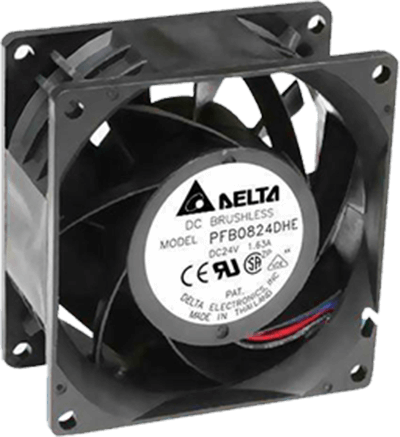
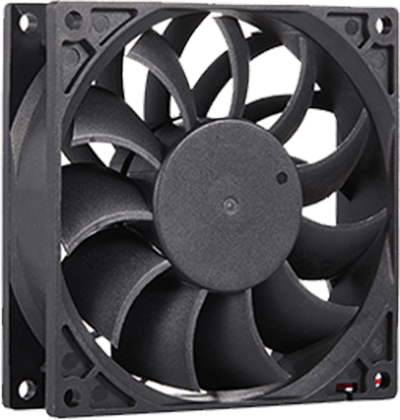
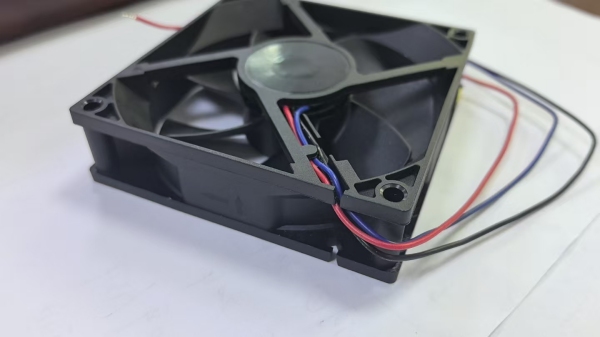
DC axial fans are widely used to remove heat from electronic equipment, control cabinets, servers, power supplies, automotive systems, and other devices. Their compact design, low-voltage operation, and flexible speed control make them a practical choice for many cooling applications.
However, a DC axial fan is not suitable for every cooling system. Its airflow, static pressure, power consumption, noise, and operating environment all affect performance. High-resistance air paths or high heat loads may require a different fan design.
This guide explains how DC axial fans work, their main advantages and limitations, how they compare with AC and centrifugal fans, and which specifications to consider when selecting a fan for a specific application.
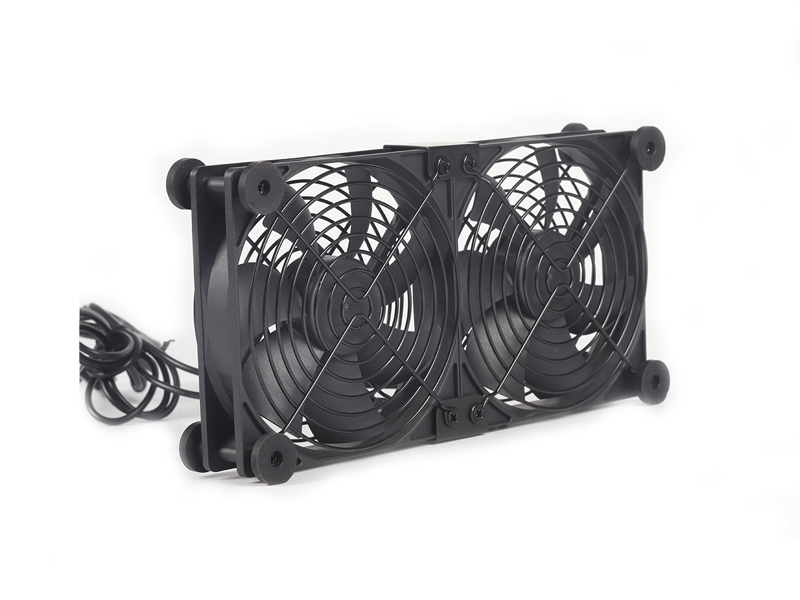
A DC axial fan uses a motor to rotate its blades and move air through the fan in a straight path. Brushless DC motors are widely used because they support compact designs and electronic speed control.
|
Fan Type |
Airflow |
Static Pressure |
Typical Use |
|
DC axial fan |
High |
Low-medium |
Electronics, cabinets |
|
High |
Low-medium |
HVAC, ventilation |
|
|
Medium |
High |
Ducts, filters, high resistance |
DC axial fans are powered by a matched DC supply or battery. When connected to AC mains, an AC-DC power supply is required. Common voltage options include 5V, 12V, 24V, and 48V, depending on the application.
DC axial fans are widely used when cooling systems need efficient airflow in a compact form. Their advantages cover power requirements, electrical characteristics, installation space, and control flexibility.
|
Advantage |
Why It Matters |
|
High efficiency |
Reduces energy use |
|
Low voltage |
Works with batteries and DC systems |
|
Low EMI |
Suitable for sensitive electronics |
|
Quiet operation |
Fits noise-sensitive environments |
|
Compact design |
Saves installation space |
|
Easy speed control |
Supports PWM adjustment |
|
Customization |
Allows tailored size, voltage, and connectors |
Brushless DC motors have fewer mechanical wear points and can support long operating life. PWM control can also balance cooling performance with noise and power use. For demanding environments, options such as water-resistant construction can be specified according to application requirements.
DC axial fans work best in low- to medium-resistance airflow paths. Dense filters, long ducts, or narrow passages can reduce actual airflow. Centrifugal fans or blower fans may be more suitable for high static pressure.
Higher fan speeds generally produce more noise. Bearings, blades, vibration, and airflow resonance can also affect acoustic performance. PWM speed reduction and vibration isolation can help.
Low voltage may cause poor startup or reduced speed, while excessive voltage can damage the fan. Check rated voltage, input range, current, and polarity before installation.
High-heat-load equipment may require multiple fans, higher-static-pressure models, blowers, or additional cooling methods rather than a single axial fan.

The three fan types differ mainly in their power requirements, airflow characteristics, and ability to handle system resistance.
|
Factor |
DC Axial Fan |
AC Axial Fan |
Centrifugal Fan |
|
Power source |
DC |
AC |
AC or DC |
|
Efficiency |
Generally high |
Generally lower |
Varies by design |
|
Speed control |
Easy |
More complex |
Depends on motor/control |
|
Airflow |
High |
High |
Moderate to high |
|
Static pressure |
Low-medium |
Low-medium |
High |
|
Size |
Compact |
Compact |
Usually deeper |
|
Typical use |
Electronics, battery systems |
HVAC, ventilation |
Ducts, filters, high resistance |
Selection should consider the system's resistance, airflow target, power source, available space, and control method. DC axial fans are often practical where low-voltage operation and adjustable speed are required, while higher-resistance systems may call for centrifugal designs.
Choosing the right DC axial fan starts with checking the specifications that directly affect cooling performance and system compatibility.
|
Specification |
What to Check |
|
Voltage & current |
Rated input and operating range |
|
Power consumption |
Available power requirements |
|
Airflow & static pressure |
Cooling demand and system resistance |
|
Size & RPM |
Installation space and speed limits |
|
Noise |
Acceptable acoustic level |
|
PWM & tachometer |
Speed control and monitoring |
|
Connector |
System compatibility |
|
Temperature & IP |
Operating environment |
|
Bearing |
Expected operating conditions |
Do not choose a fan based on voltage alone. Two 12V DC fans can have very different airflow, static pressure, current, and power requirements.
The application then determines which combination of airflow, noise, durability, and environmental protection is most important.
|
Application |
Key Requirements |
|
Electronic enclosure |
Compact size, airflow, low noise |
|
Server/power supply |
Airflow, static pressure, reliability |
|
Medical equipment |
Low noise, low EMI, reliability |
|
Automotive |
Wide voltage range, vibration resistance |
|
Industrial cabinet |
Airflow, durability, dust protection |
|
Battery/solar system |
DC voltage, efficiency, low power |
Finally, different equipment requirements may call for different fan designs, including DC, AC, EC axial fans, blowers, or centrifugal fans. Customized options can cover size, voltage, airflow, connector, and PWM requirements, while CFM, noise, temperature-cycle, and salt-spray testing can help verify suitability for demanding applications.

DC axial fans offer an efficient, compact, low-voltage cooling solution with quiet operation and flexible speed control. However, their static pressure capability, high-speed noise, and performance in high-heat-density systems should be considered before selection. Choosing the right fan requires more than checking voltage. Airflow, static pressure, power, noise, size, and operating environment should all match the application.
EISKUHL provides DC, AC, and EC axial fans, blowers, and centrifugal fans for different cooling requirements. Options can be tailored by voltage, size, airflow, connector, PWM, and other specifications. Contact EISKUHL for DC axial fan selection or customized cooling solutions.
Are DC axial fans better than AC fans?
It depends on the application. DC fans suit low-voltage systems, speed control, batteries, and electronics, while AC fans are convenient for mains-powered ventilation.
Can DC axial fans run on batteries?
Yes. The battery voltage must match the fan requirements and provide sufficient current. Check polarity and use appropriate fuse protection.
Do DC axial fans need an AC-DC converter?
Not always. A matched DC supply or battery can power the fan directly. An AC-DC converter is needed when using AC mains.
Can DC axial fans handle high static pressure?
Usually not. Centrifugal fans or blowers are generally more suitable for high-resistance airflow paths.
Why is my DC fan running slowly?
Common causes include low input voltage, voltage drop, undersized wiring, blocked airflow, excessive system resistance, or an incorrect PWM signal.