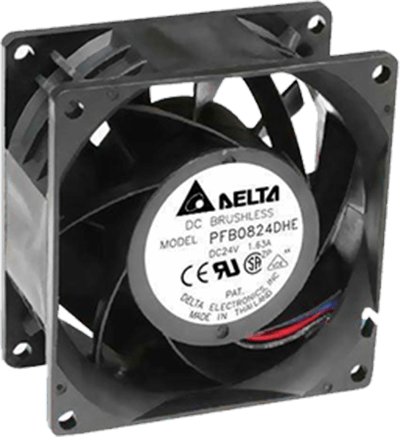
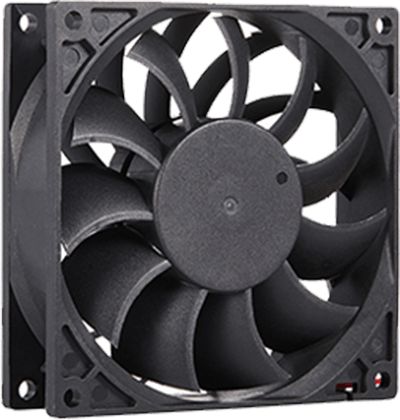
Mini DC fans are widely used in compact electronic devices, embedded systems, industrial controllers, and other equipment that requires efficient heat dissipation in limited spaces. Among the available options, 5V and 12V mini DC fans are common choices for different power supply configurations.
But which voltage is right for your application? The answer depends not only on the available power supply but also on airflow requirements, current consumption, noise levels, installation constraints, and operating conditions.
In this guide, we compare 5V vs. 12V mini DC fans and explain how to choose the right cooling fan for your equipment.

The primary difference is the fan's rated operating voltage. A 5V mini DC fan is designed to operate under its specified 5V DC conditions, while a 12V mini DC fan is designed for a nominal 12V DC supply.
Both types use a motor to rotate the blades and move air through or around electronic equipment. Their suitability depends on the electrical system and the cooling performance required by the application.
|
Feature |
5V Mini DC Fan |
12V Mini DC Fan |
|
Rated voltage |
5V DC |
12V DC |
|
Power supply |
Compatible 5V DC source |
Compatible 12V DC source |
|
Typical applications |
Low-voltage electronic devices and embedded systems |
Industrial controllers, communication equipment, and electrical modules |
|
Main consideration |
Available 5V power and cooling capacity |
Available 12V power and cooling capacity |
These are general application examples rather than strict rules. Both voltage options may be suitable for many types of equipment, provided their specifications meet the system requirements.
Airflow is a critical factor when selecting a mini DC cooling fan. It describes the volume of air moved over a specific period and is commonly measured in cubic feet per minute (CFM) or cubic meters per hour (m³/h).
Static pressure describes the fan's ability to overcome resistance from vents, filters, heat sinks, and other obstructions in the airflow path.
A common misconception is that a 12V fan always delivers more airflow than a 5V fan. In reality, voltage alone does not determine cooling performance. Motor design, rotational speed, blade geometry, fan dimensions, and thickness all influence airflow and pressure.
When comparing 5V and 12V mini DC fans, review their rated airflow, static pressure, and pressure-flow (P-Q) curves where available. This helps determine whether a fan can deliver sufficient airflow under actual installation conditions.
Voltage and current are important when evaluating the electrical requirements of a cooling fan. The relationship between voltage, current, and electrical power can be expressed as:
Power (W) = Voltage (V) × Current (A)
For example, a 5V fan drawing 0.2A consumes approximately 1W of electrical power. A 12V fan drawing 0.1A consumes approximately 1.2W.
This illustrates why a lower-voltage fan does not automatically consume less power. Actual consumption depends on the current drawn by the specific model.
Before choosing a mini DC fan, check the rated current and ensure the power supply can support the fan's operating requirements, including startup current where applicable. This is particularly important for battery-powered devices and systems with limited power budgets.
Noise is another important consideration, especially in office equipment, laboratory instruments, and other noise-sensitive applications.
Fan noise depends on rotational speed (RPM), blade design, bearing type, airflow resistance, vibration, and installation conditions. Neither 5V nor 12V fans are inherently quieter in every situation.
When low-noise operation is important, compare the manufacturers' noise ratings and RPM specifications. Also consider how the fan will perform once installed in the enclosure, since restricted airflow and vibration can affect actual noise levels.
Rated voltage does not determine the physical dimensions of a mini DC fan. Fans with the same frame size may be available in both 5V and 12V versions, with different performance characteristics.
Check the following before selecting a model:
A fan that matches the available voltage but does not fit the enclosure or provide sufficient cooling is not the right choice.

Using a fan outside its specified voltage range can lead to unreliable operation or damage.
Running a 5V fan on 12V: Applying 12V directly to a fan rated for 5V may cause excessive speed, overheating, damage to the motor electronics, or premature failure. Do not do this unless the manufacturer explicitly specifies that the model supports the voltage.
Running a 12V fan on 5V: A 12V fan supplied with only 5V may fail to start, operate at a lower speed, or provide insufficient airflow. The result depends on the fan's motor design and specified operating-voltage range.
If the available supply voltage does not match the fan's rating, a suitable DC-DC converter may be an option. The converter must support the fan's current requirements and startup behavior. In many cases, selecting a fan that matches the existing power supply is the simpler solution.
Follow these steps to select the appropriate mini DC cooling fan:
A structured selection process helps avoid electrical compatibility issues and reduces the risk of inadequate thermal performance.
Choosing between a 5V and a 12V mini DC fan starts with the available power supply, but the final decision should also account for airflow, static pressure, power consumption, noise, installation dimensions, and operating conditions. Neither voltage is universally better; the right choice is the model that meets your equipment's electrical and thermal requirements.
Review the manufacturer's specifications and validate the selected fan under realistic operating conditions before finalizing your design. If you need help comparing fan sizes, voltage options, or cooling performance, EISKUHL provides mini DC axial fan solutions to support cooling requirements across electronic devices, industrial equipment, and compact systems.