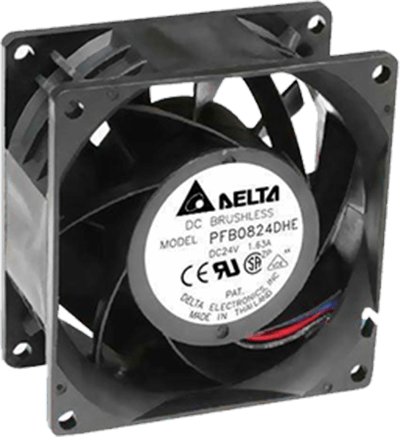
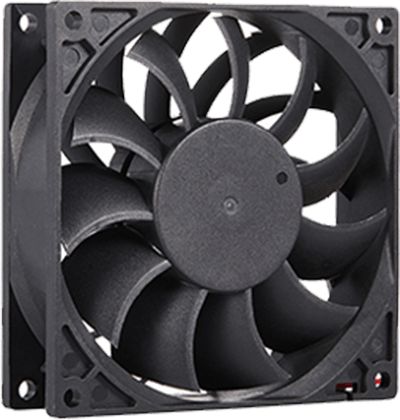
Mini DC axial fans play an important role in cooling compact electronic devices, industrial controllers, communication equipment, and other space-constrained systems. As electronic components become smaller and more powerful, effective heat dissipation is increasingly important for maintaining stable performance and extending equipment service life.
However, choosing the right mini DC axial fan involves more than selecting a fan that fits the available space. Airflow, static pressure, voltage, power consumption, noise, bearing type, and operating environment all affect cooling performance.
This guide explains the key factors to consider when selecting a mini DC axial fan for your application.

A mini DC axial fan is a compact cooling device powered by direct current (DC). It moves air along the axis of its rotating blades, helping remove heat from electronic components and equipment enclosures.
Compared with larger cooling fans, miniature DC axial fans are designed for applications where installation space is limited. Their compact dimensions and compatibility with low-voltage power supplies make them suitable for embedded systems, small electronic devices, control equipment, and compact power modules.
Mini axial fans are different from centrifugal blower fans. Axial fans generally move air straight through the fan, while blowers redirect airflow through an outlet. The right choice depends on the available space, airflow path, and pressure requirements of the cooling system.
Before selecting a small DC cooling fan, determine what needs to be cooled and how air will move through the equipment.
Common applications include:
Consider the equipment's heat output, maximum allowable operating temperature, ventilation openings, and expected operating conditions. These factors help establish the cooling performance required from the fan.
Physical dimensions are among the first specifications to check when selecting a mini DC axial fan. Common miniature sizes include 20 mm, 25 mm, 30 mm, 40 mm, and 50 mm, although available dimensions vary by manufacturer and product series.
Smaller fans are useful when installation space is extremely limited, but they may have less airflow capacity than larger models. A larger fan may provide greater airflow potential, provided that the equipment can accommodate its dimensions and mounting requirements.
|
Fan size range |
Typical selection considerations |
|
20–30 mm |
Very compact electronic modules and space-constrained devices |
|
35–40 mm |
Small electronic assemblies and embedded equipment |
|
40–50 mm |
Compact enclosures and electronic control equipment |
These are general guidelines rather than fixed application rules. Actual performance depends on fan thickness, rotational speed, blade design, and other specifications.
Before purchasing a miniature axial fan, verify its frame dimensions, thickness, mounting-hole positions, connector type, and cable clearance. Even a small dimensional difference can affect installation compatibility.
Airflow and static pressure are two essential parameters when choosing a mini DC cooling fan.
Airflow describes the volume of air the fan moves over a given period. It is commonly measured in cubic feet per minute (CFM) or cubic meters per hour (m³/h). Adequate airflow helps carry heat away from electronic components.
Static pressure indicates the fan's ability to overcome resistance in the airflow path. This becomes especially important when air must pass through narrow vents, filters, heat sinks, or densely packed components.
A fan with a high maximum airflow rating may not deliver the same airflow once installed inside an enclosure. Actual performance depends on the resistance of the complete cooling system.
When comparing small DC axial fans, review the fan's pressure-flow (P-Q) curve if available. This curve shows how airflow changes as static pressure increases and helps engineers evaluate whether a fan can meet the system's requirements.

(Reference diagram for PQ curves)
Rather than choosing a fan based on maximum airflow alone, consider how it will perform in the actual installation.
Mini DC axial fans are available with different rated voltages, including 5V and 12V models. The appropriate option depends on the equipment's power supply and the electrical requirements of the fan.
Check the following specifications before making a selection:
Some mini DC fans use two wires for power and ground, while three-wire models may include a tachometer or frequency generator (FG) signal for speed monitoring. Pulse-width modulation (PWM) speed control is another option when supported by the fan and the control system.
Always confirm the manufacturer's wiring diagram and electrical specifications rather than assuming that all fans with the same number of wires have identical functions.
Rotational speed, usually expressed in revolutions per minute (RPM), affects a fan's airflow and pressure characteristics. However, a higher RPM does not automatically guarantee better cooling in every application. Noise, power consumption, and the resistance of the airflow path must also be considered.
For equipment used in offices, laboratories, or noise-sensitive environments, acoustic performance may be an important selection criterion. For industrial equipment, the priority may be maintaining sufficient cooling under continuous operating conditions.
Bearing type also influences fan selection. Sleeve bearings and ball bearings have different design characteristics, costs, and operating requirements. Their suitability depends on factors such as mounting orientation, temperature, operating hours, and expected service life.
Review the manufacturer's noise ratings, bearing specifications, and service-life information to determine whether a particular miniature cooling fan meets your requirements.
A mini DC axial fan must be suitable for the environment in which it will operate. Consider the following conditions:
Not every miniature DC fan is designed for harsh environments. If the equipment operates in dusty, humid, or high-temperature conditions, select a model whose documented specifications match those requirements.

Although both designs can provide cooling for compact equipment, they suit different airflow arrangements.
|
Feature |
Mini DC axial fan |
Mini blower fan |
|
Airflow direction |
Generally parallel to the rotational axis |
Air is redirected through an outlet |
|
Installation |
Often suited to straight-through airflow paths |
Can accommodate directed airflow paths |
|
Selection factors |
Airflow, system resistance, and mounting space |
Outlet geometry, pressure requirements, and duct design |
|
Typical use |
Electronic enclosures and compact equipment |
Localized cooling and applications requiring directed airflow |
Neither design is universally better. Compare the performance curves, installation geometry, and cooling requirements of the available models before deciding.
Choosing the right mini DC axial fan requires balancing physical dimensions, airflow, static pressure, electrical compatibility, noise, and environmental requirements. By evaluating these factors together, equipment manufacturers and engineers can identify a cooling solution that fits both the installation space and the thermal demands of the application.
Before finalizing your selection, review the product datasheet, check the available pressure-flow curve, and verify compatibility with your equipment. If standard models do not meet your requirements, consult a cooling fan supplier about alternative specifications or customization options.
With a range of compact cooling solutions and application-focused technical support, EISKUHL helps customers identify suitable DC axial fans for electronic devices, industrial equipment, and other space-constrained cooling applications.