Choosing the right fan is one of the most critical decisions in any cooling system design. Whether you are working on industrial equipment, electronic enclosures, power supplies, automotive modules, medical devices, or communication systems, the performance and reliability of your cooling fan directly affect system stability, lifespan, and user experience.
Among the many cooling fan options available on the market, Delta fans are widely recognized for their high airflow, strong static pressure, long lifespan, and excellent reliability. However, even with a high-quality brand like Delta, selecting the wrong model can still result in overheating, excessive noise, wasted energy, or premature system failure.
This article provides a practical, step-by-step guide on how to choose the right Delta fan for your cooling system, helping you balance airflow, pressure, noise, size, and reliability.
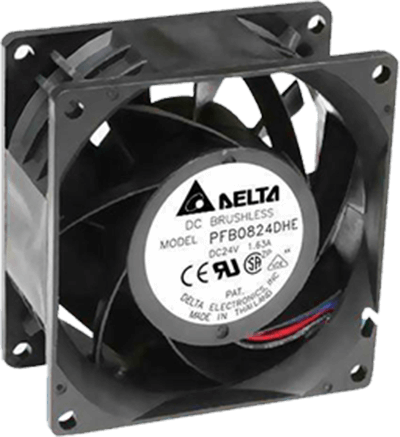
Delta fans are cooling fans manufactured by Delta Electronics, a global leader in power and thermal management solutions. Delta offers a wide range of DC axial fans, DC blower fans (centrifugal fans), and AC fans, covering multiple sizes, voltages, airflow ratings, and protection levels.
They are commonly used in:
Industrial control cabinets
Servers and data centers
Power supplies and inverters
Automotive electronics
Telecom equipment
Medical and laboratory devices
Delta fans are preferred in professional cooling systems because they offer:
High airflow (CFM) and high static pressure
Stable performance under harsh conditions
Long service life with ball bearing or FDB bearing options
Low-noise fan models with optimized blade design
PWM speed control and monitoring functions
Wide operating temperature range
Before selecting any fan model, you must clearly understand your system’s cooling needs.
Start by identifying how much heat your system generates. This is usually measured in watts (W). Key questions include:
How much power do the components dissipate?
Is the system running continuously or intermittently?
What is the maximum allowable operating temperature?
Higher heat loads require higher airflow or higher static pressure fans.
Airflow is typically measured in CFM (cubic feet per minute) or m³/h. As a general rule:
Higher heat = higher airflow requirement
Compact enclosures need efficient airflow distribution
However, airflow alone is not enough. Many systems fail because designers only look at maximum CFM values.
Static pressure becomes critical when airflow is restricted by:
Heat sinks
Air filters
Dust screens
Narrow ducts
Dense internal components
In these cases, a high static pressure DC fan or DC blower fan is often more effective than a standard axial fan.
DC axial fans:
Best for open or low-resistance systems
High airflow with low-to-medium pressure
Common in enclosures, power supplies, and electronics cooling
DC blower fans (centrifugal fans):
Designed for high-pressure environments
Suitable for ducted airflow paths
Ideal for compact systems with filters or long airflow channels
Choosing the wrong fan type is a common reason for poor cooling performance.
In most modern cooling systems, DC fans are preferred because they offer:
Higher energy efficiency
Better speed control
Lower noise levels
Easier integration with electronic control systems
AC fans are typically used in large industrial equipment where speed control and noise are less critical.
Delta fans are available in standard sizes such as:
40mm, 60mm, 80mm
92mm, 120mm, 140mm
Larger sizes for industrial cooling
Choose a fan size that fits your enclosure without restricting airflow or increasing vibration.
Fan thickness affects performance:
Thicker fans generally provide higher airflow and static pressure
Slim fans save space but may have lower performance
When space is limited, selecting a high-performance slim DC fan becomes essential.
One of the most important but often overlooked steps is reading the fan performance curve.
A fan curve shows the relationship between:
Airflow
Static pressure
Your system has its own resistance curve. The actual operating point is where the fan curve intersects the system curve.
Many users choose a fan based on maximum airflow alone. In real systems with airflow resistance, the actual airflow can be much lower. Selecting a Delta fan with adequate static pressure ensures reliable cooling under real conditions.
Fan noise is measured in dBA, but perceived noise depends on:
Frequency
Environment
Installation method
A fan with slightly higher dBA but smoother airflow may sound quieter than a high-pitched fan with lower dBA.
High-speed fans generate more noise. Solutions include:
Choosing low-noise Delta fan models
Using PWM control to reduce speed when full cooling is not needed
Selecting optimized blade designs
For applications like medical devices, office equipment, or beauty devices, low-noise DC fans are especially important.
Common Delta DC fan voltages include:
5V Delta DC fan
24V Delta DC fan
48V Delta DC fan
Always match the fan voltage to your system power supply to avoid instability or fan damage.
Advanced Delta fans support:
PWM speed control
FG (tachometer) signal for RPM monitoring
Alarm or lock detection
These features help improve energy efficiency and system safety.
Ensure the fan can operate reliably within your system’s temperature range. High-temperature environments require specially designed motors and bearings.
Ball bearing fans: Long lifespan, good for high temperatures
Fluid Dynamic Bearing (FDB) fans: Lower noise, smooth operation, ideal for noise-sensitive applications
For harsh environments, consider:
Dustproof fans
Waterproof fans with IP ratings
Corrosion-resistant materials
These features are essential in outdoor, industrial, or high-humidity applications.
Choosing the right Delta fan for your cooling system requires more than selecting a fan with the highest airflow rating. A successful selection balances airflow, static pressure, noise, size, voltage, control features, and environmental durability.
By understanding your system requirements and using fan performance data correctly, you can ensure stable cooling, long-term reliability, and optimal performance for your application.
EISKUHL specializes in high-performance cooling solutions, including DC axial fans, DC blower fans, low-noise cooling fans, and custom thermal management solutions for industrial, automotive, electronics, and consumer applications. With a focus on efficiency, reliability, and noise optimization, EISKUHL helps customers select and integrate the right cooling fan solutions to meet demanding thermal requirements.